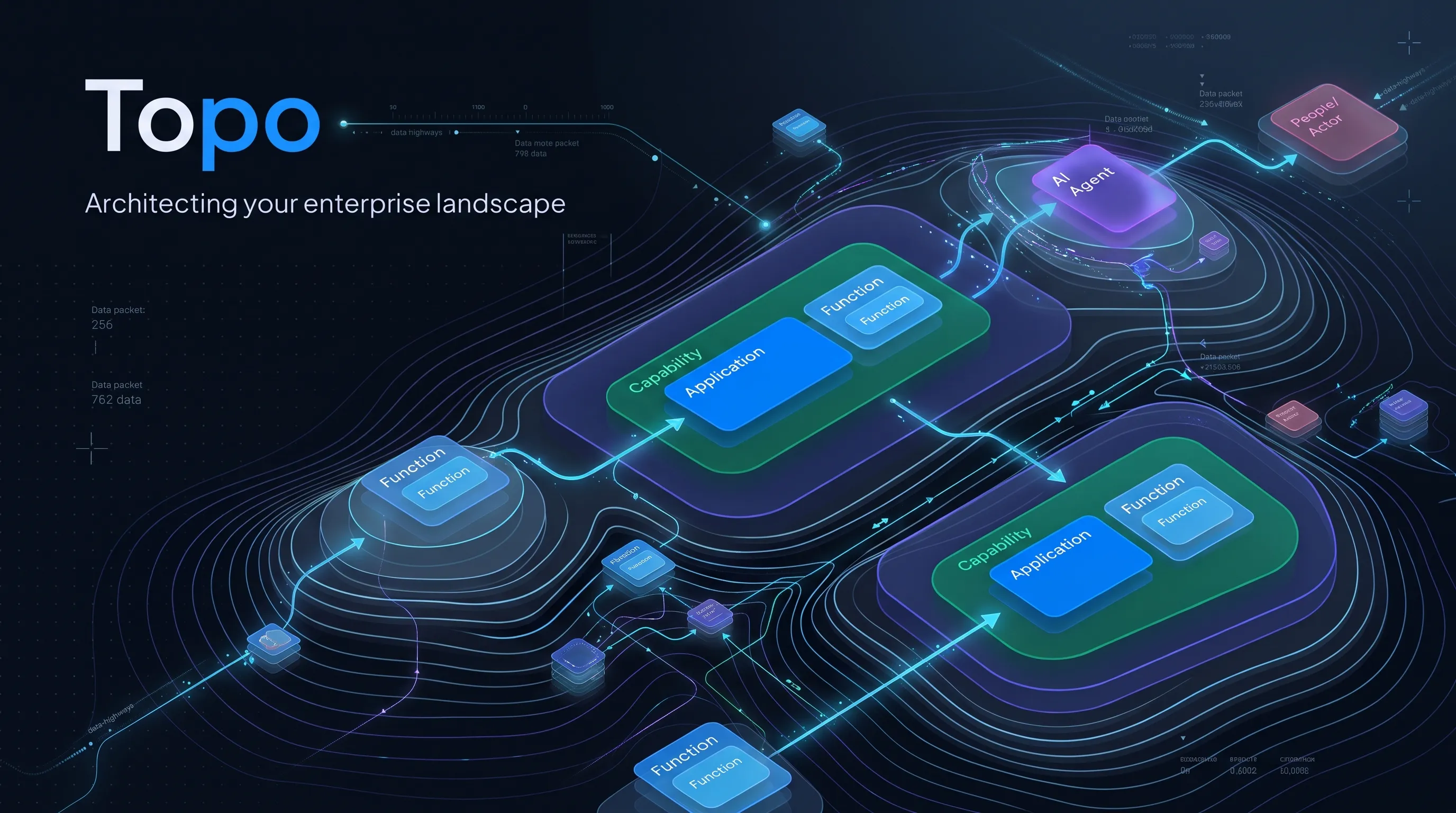
In 1933 Harry Beck made a London Underground map.
It was geographically wrong.
It was also the most useful transit diagram ever drawn.
He threw away actual distances, flattened the Thames, constrained every line to horizontal, vertical, or forty-five degrees. Nobody needed geographic accuracy. Everyone needed to know how to get from here to there and where to change.
Nobody has yet made a Harry Beck version of a technology estate. This is an attempt to do something about that.
Why Architecture Diagrams Are Mostly Useless
The standard artefacts of enterprise architecture (the system landscapes, the integration diagrams, the “current state” boxes and arrows) tend to fail in a specific way. They try to be accurate: every system, every integration, box sizes and arrow weights all assigned meaning. Then nobody can agree on what any of the sizes and weights mean, and the diagram becomes a conversation about the diagram rather than about the technology estate it describes.
Technically thorough. Practically useless. It describes the archaeology of a technology estate: how decisions accumulated over time, what got connected to what, where the bodies are buried. It does not answer “what is this estate actually capable of” or “where does investment need to go” or “what happens when this system is decommissioned.” The diagram does not answer any of them.
A Minimum Viable Model
The question I kept coming back to was not “how do we model technology estates” but “what is the minimum number of types of thing you need to represent for the model to be genuinely useful.” It stops you adding things because they are real. Everything has to help someone make a decision.
Enterprise architecture has historically been done by architects for architects. The artefacts it produces are often incomprehensible to the people who have to act on them: the finance director approving investment, the operations lead owning the capability, the engineer being told what to build. A model that only a trained architect can read or build serves only the architects. Architecture should not require an interpreter.
The answer, after more whiteboard sessions than I am going to list here, was five primitives.
Five types of thing. If you can describe your technology estate in terms of these five things and the relationships between them, you have enough to reason about capability, investment, maturity, risk, and change. If you cannot, the model needs to be extended. After a little while of using it, that has happened once, and the extension was eventually rolled back.
The Five Primitives
Domain is a business area. Not a team. Not an application. Not a cost centre. A business area: a coherent set of activities that the organisation does. Payments. Customer Support. Logistics. The boundary is not drawn by the org chart or the IT estate. Getting this right is harder than it sounds and tends to be where the most useful conversations happen, usually because two people who thought they agreed about scope discover, in the act of drawing the boundary, that they did not.
Capability is what a Domain can do. Customer Support can handle inbound queries. It may also do proactive outreach. Each Capability has a maturity level from one to five. This turns “our query handling is a bit rubbish” into a number, which makes it possible to compare, track, and prioritise without spending the first forty minutes of every meeting arguing about what “a bit rubbish” means to different people in the room.
Application is what delivers a Capability. It is a piece of software, categorised by deployment type: SaaS, PaaS, Custom, or AI Agent. The deployment type is not decoration. A SaaS application changes when the vendor changes it. A Custom application changes when you decide to change it and fund the work. AI Agent is a recent addition: agents that call tools and return results now have their own cost profile, change characteristics, and risk shape.
Flow is how Apps communicate. It has a type: REST, Events, batch, file transfer. A Flow without a type is an arrow that says “these two things are connected somehow,” which is nearly no information at all. The difference between REST and Events is an architectural decision with real consequences.
People is who interacts with the system. Not an org chart. The actor at the boundary between human and technology. A People node can represent a named individual, a general role, a team, or an external company. An estate with no People nodes is describing itself to itself.
Five things. Everything else is derived from them.
A WordPress site with Algolia powering the search: one Domain (Content and Discovery), two Capabilities, three Apps (WordPress as Custom, the theme as PaaS, Algolia as SaaS), a REST Flow for search queries, one People node. What the deployment types tell you immediately is that swapping the search provider is a configuration decision, not a rebuild.
One Model, Multiple Questions
These are not separate diagrams. They are different lenses on the same model. Separate diagrams for different questions will not stay in sync. Within six months you have three documents that partially contradict each other and a team that has quietly stopped believing any of them. This is not a hypothetical failure mode.
One model, updated in one place. Keeping one model accurate is less work than keeping five documents from quietly contradicting each other.
There is no synchronisation problem because there is nothing to synchronise.
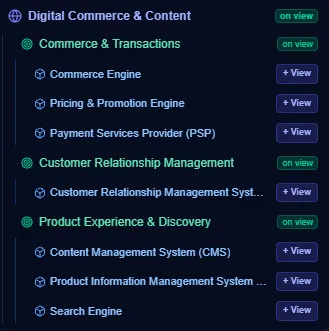
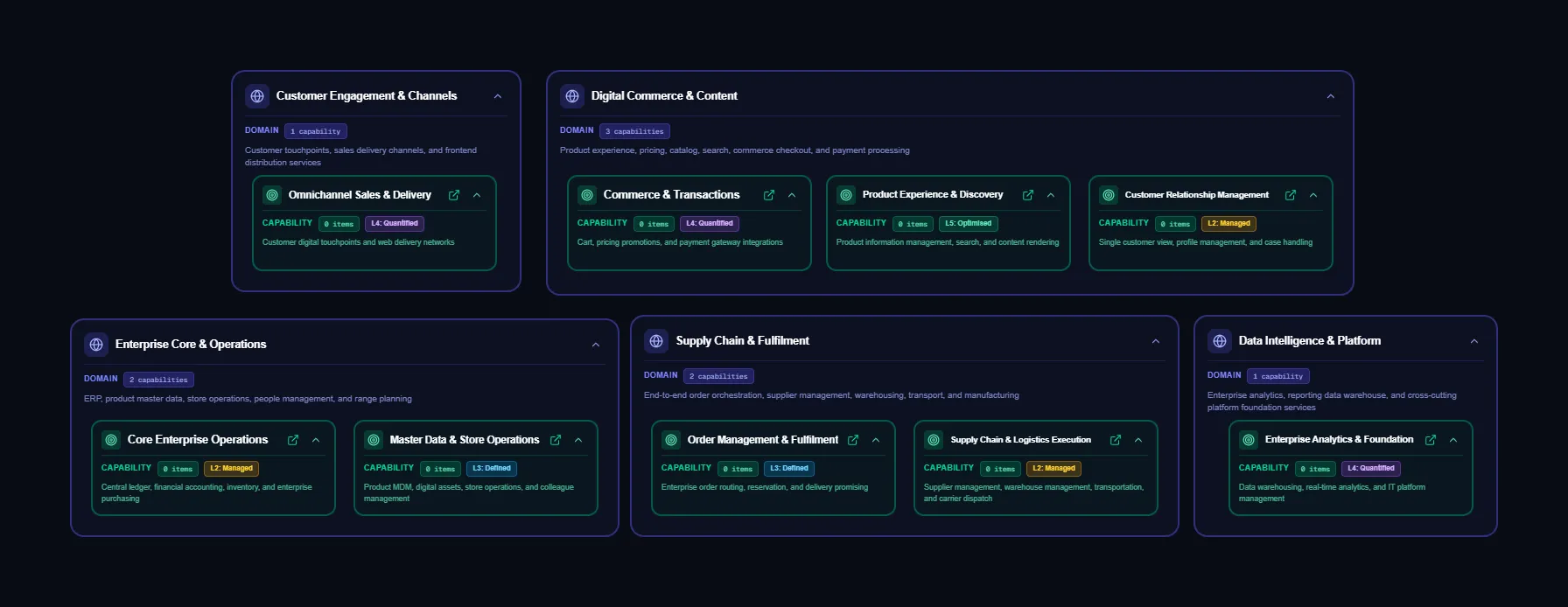
The same retail estate as a capability map: five domains, eight capabilities, each with a maturity rating.
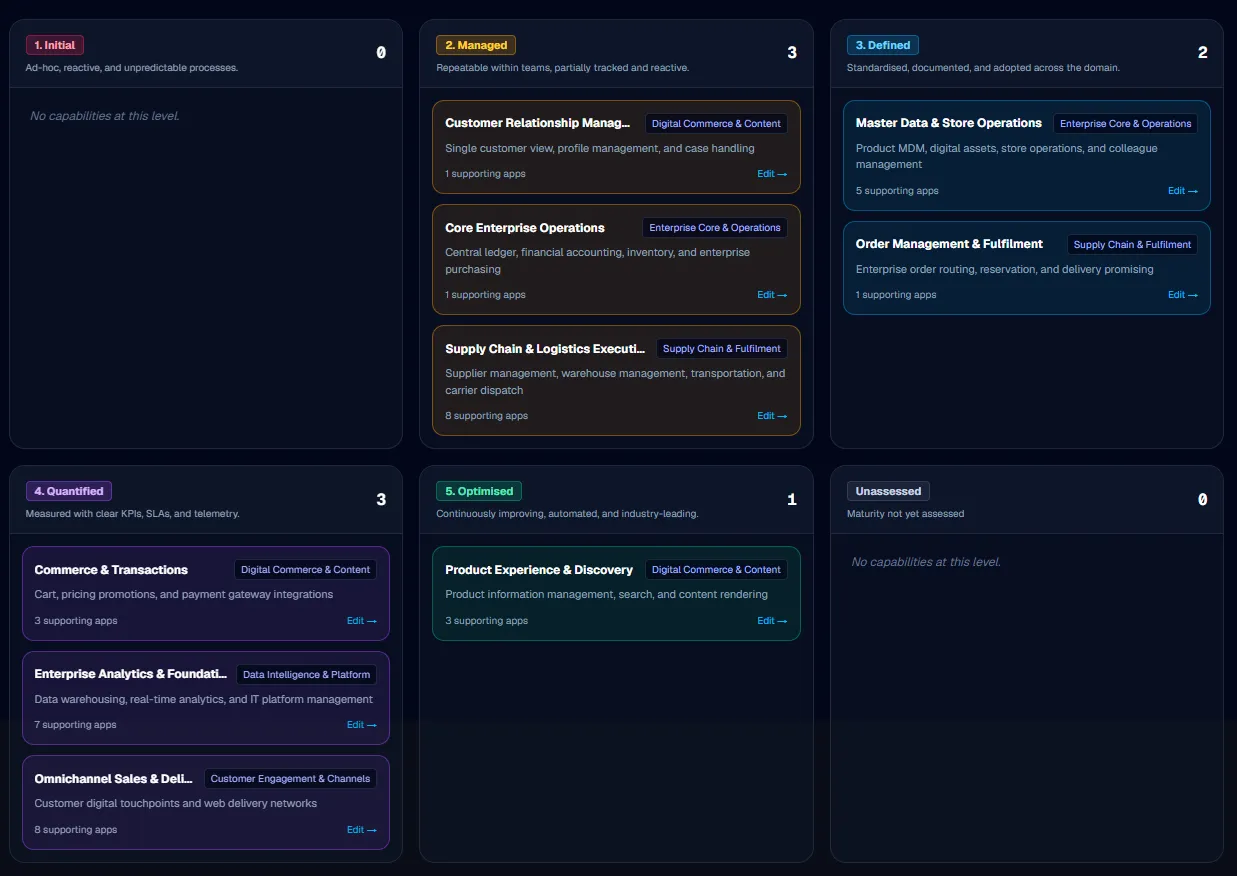
Filter by maturity and the same eight capabilities, sorted by scale, make the investment question immediate without entering any new data.
What It Does Not Solve
A model is not the estate. This one is not an exception.
Topo sits between process modelling and system architecture. Process was cut because BPMN does it better. At the other end, C4 handles how a specific system is built inside. Topo records that an Order Engine exists, what Capability it delivers, and what Flows connect it. How it is built is a question for C4.
The primitives are precise. The information in them is not always. A Domain boundary drawn badly produces a model that accurately describes a badly drawn Domain. The model is only as good as the conversation that produced it, and organisations are complicated.
The model does not say what to do. That comes from people applying judgement to what it surfaces.
What it does is give that conversation a shared object to argue about. Most architecture discussions fail not because people disagree about priorities but because they are describing different models of the same estate without realising it. One model, understood to be the reference, changes that.
AND FINALLY
The name. Topo compresses topography and topology: the shape of the terrain and the properties of its connections. Neither requires geographic accuracy, which is rather the point.
Beck’s Underground map committed to answering one question well. It tells you they are on the same line, which is all that matters.
This is an attempt at the same trade as Beck’s map. Five primitives, one model, multiple lenses. Not a complete description of a technology estate (no map is) but enough to understand what it can do, where it is weak, and what needs to change.
The hardest part was not building it. It was accepting that five things was enough.
If you work in enterprise architecture, or have to make decisions based on it, I would like to know: what does the architecture conversation in your organisation actually argue about?