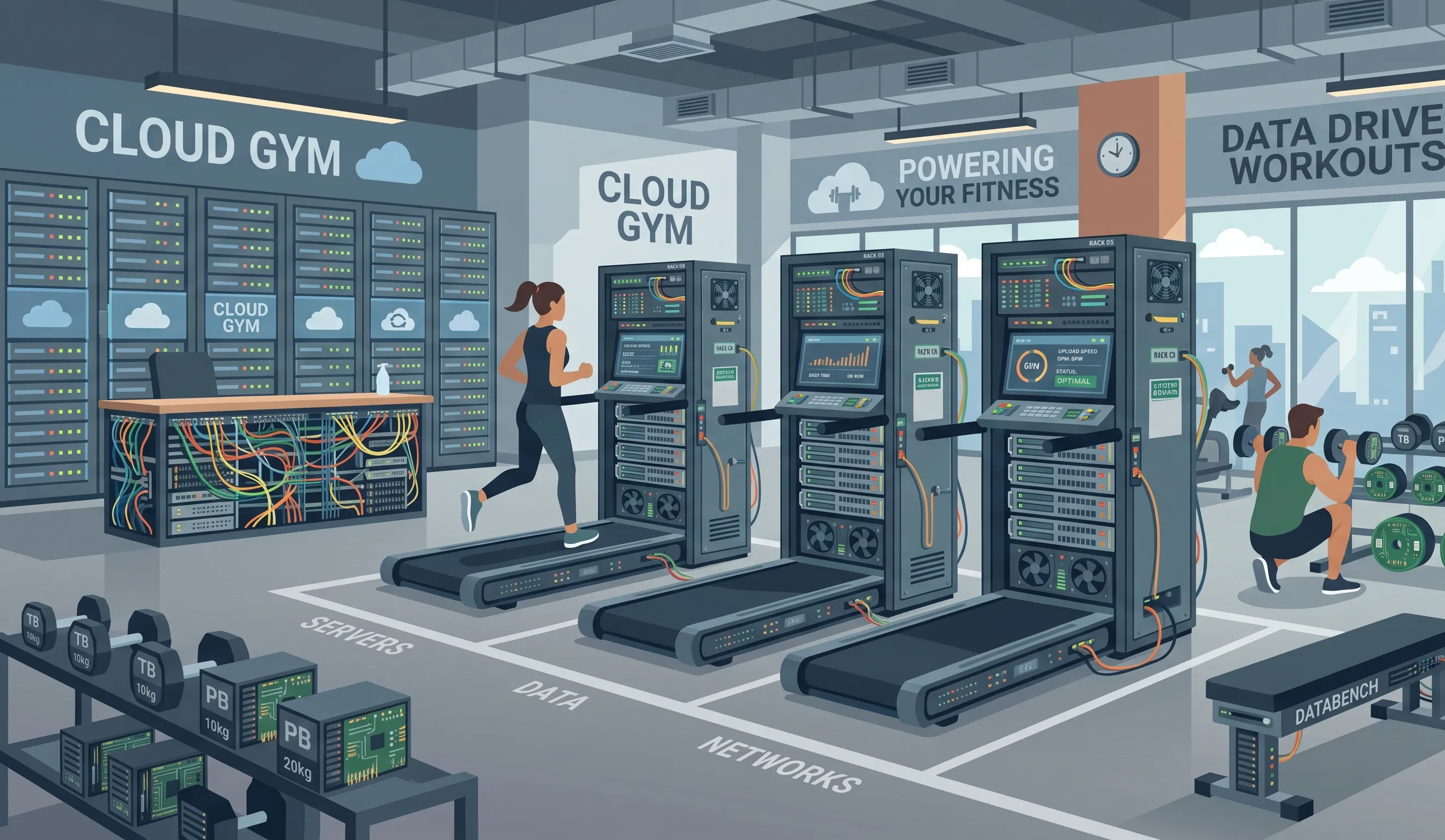
There’s a specific kind of pain that comes from checking your bank statement in March and finding the gym membership you’ve been “about to cancel” since February. It’s not sharp. It’s a dull, resigned throb, the financial equivalent of a knowing nod.
Your cloud bill does the same thing. Every month. Except it’s usually larger.
Obviously this isn’t the most technical cloud cost management post you’ll read this year, but it might be the most relatable. That should concern you.
The Sign-Up
Every gym membership story starts in January. There’s optimism, there are spreadsheets, there is absolute certainty that this time it’s different. The cloud migration conversation follows the same arc: a compelling business case, a proof of concept that goes suspiciously well, and a set of projections built on the assumption that engineers will immediately and permanently switch off things they’re no longer using.
They won’t. You knew this. You signed the contract anyway.
The Personal Trainer You Never See
Most cloud providers offer reserved instances or committed use discounts, promise to consume a certain amount of compute for one or three years, and you get a significant reduction versus paying on-demand. The pitch is compelling. The maths is compelling.
And then, in the way of all good intentions, the reservation quietly ticks away while the actual workloads have migrated to a different instance type, in a different region, consuming entirely on-demand capacity at full price.
The personal trainer is booked, paid for, and technically available. Nobody has seen them since the introductory session.
Classes You’ve Booked But Won’t Attend
Idle resources are the 6am spin class that seemed perfectly achievable on a Monday evening. Development environments left running over weekends. Staging servers that outlived the project they were staging. Oversized instances provisioned on the basis that “we might need the headroom” by someone who has since left the organisation.
According to Gartner, somewhere between 30–35% of cloud spend is waste. That’s a lot of empty treadmills.
The genuinely tricky part is that unlike the spin class, nobody is actively aware they’ve booked it. The auto-renew just keeps renewing.
The Mysterious Direct Debit
Open your cloud bill, the real one, not the headline number on the dashboard. There will be charges in there you cannot immediately explain. Data transfer between availability zones. NAT gateway processing fees. API calls to a service that was part of an experimental proof of concept in 2023 and has been making 400 requests a day to nothing in particular ever since.
Each charge is small. Collectively, they are not.
This is the £1/month locker key, the optional hydration tracking add-on, the guest passes purchased in a moment of optimism. Individually: fine. On a bill: a minor detective story with a depressing resolution.
Actually Going to the Gym
FinOps, the practice of bringing genuine financial accountability to cloud spend, is essentially hiring a personal trainer who actually shows up. The good ones don’t just present the bill; they hold the organisation accountable for what’s on it, and they make the conversation between finance and engineering less adversarial than it currently is.
The fundamentals aren’t complicated. Tag your resources properly so you know what is spending what. Review your reservations before they auto-renew. Automate shutdowns for non-production environments outside working hours. Establish someone whose job it is to care about this, and give them the access to do something about it.
None of that requires a specialist qualification. It does require someone to care, which is harder to arrange than it sounds when everyone is focused on shipping features.
The Cancellation Conversation
Here’s where the analogy gets uncomfortable.
With a gym, cancellation is annoying but achievable. You fill in a form, endure a mildly guilt-inducing conversation with someone in a polo shirt, and it’s done. The direct debit stops.
Cloud egress costs are the gym’s cancellation policy. Moving significant volumes of data out of a cloud provider costs money, sometimes quite a lot of it. This is a well-documented feature of the landscape and not, technically, anyone’s fault. It does mean that the “we can always leave if it doesn’t work out” comfort blanket has some notable holes in it.
This isn’t a reason not to be in the cloud. It is a reason to make sensible architectural decisions about data locality and to avoid placing everything in one provider’s ecosystem on the basis that you’ll address the lock-in “later”.
Later always comes.
So, to summarise what is either a pithy business insight or a light workout in extended metaphor:
- Cloud migrations are budgeted by optimists. Operate accordingly.
- Reserved instances only save money if you’re actually using the right ones.
- Idle resources are invisible until they appear on a quarterly review.
- Small charges compound. Read the whole bill.
- FinOps is financial hygiene, it shouldn’t need to be a specialist function, but it usually ends up being one.
- Egress costs are real. Plan for them before you need to.
The gym will still be there in January. So will the cloud salesperson.